Die Wechselwirkungen zwischen Ernährungssicherheit und Sicherheit zeigen sich weltweit auf unterschiedliche Weise. Die folgenden Beiträge beleuchten Perspektiven aus verschiedenen Regionen und verdeutlichen, wie Konflikte, Klimawandel, Ungleichheit, geopolitische Spannungen und Störungen der Ernährungssysteme im jeweiligen regionalen Kontext zusammenwirken.
Zunehmende Militarisierung, geopolitische Spannungen und eine verschärfte Machtpolitik rücken staatszentrierte Sicherheitskonzepte wieder stärker in den Mittelpunkt politischer Debatten. Doch die miteinander verknüpften Krisen unserer Zeit machen die Grenzen dieses Verständnisses deutlich. Konflikte, Klimawandel, wirtschaftliche Schocks, Ungleichheit und Vertreibung verstärken sich häufig gegenseitig.
Der Welthunger-Index 2026 zeigt, dass Ernährungssicherheit eine zentrale Rolle in diesen wechselseitigen Dynamiken spielt und selbst ein wesentlicher Bestandteil eines umfassenderen Sicherheitsverständnisses ist. Die folgenden Beiträge beleuchten aus unterschiedlichen regionalen Perspektiven, was „Keine Sicherheit ohne Ernährungssicherheit“ bedeutet.
Die hier geäußerten Ansichten geben die Meinung der Autor*innen wieder und entsprechen nicht notwendigerweise den Ansichten des Global Hunger Index (GHI), seiner Partnerorganisationen oder der Institutionen, denen die Autor*innen angehören.

The West Asia and North Africa (WANA) region faces a food security dilemma rooted in water scarcity, energy dependence, climate- and water-related shocks, conflict, and global market volatility.

The recent convergence of climate shocks, geopolitical conflict, supply chain disruptions, financial instability, and democratic fragility has revealed that food security in Europe is inseparable from broader questions of national and regional security.

Asia is highly exposed to climate-driven food insecurity, yet adaptation finance flows to the region remain inadequate relative to the scale of its exposure and needs.

The disruptions to trade unfolding in the Strait of Hormuz have rippled through the Horn of Africa (HoA)—here comprising Djibouti, Ethiopia, Eritrea, Kenya, Somalia, South Sudan, Sudan, and Uganda—further eroding the region's already fragile baseline of stability and food security.

Food and nutrition security is particularly fragile in the Sahel region as it faces severe climatic conditions and an entanglement of economic, health, and security crises (Olivier de Sardan 2023).

Global military expenditures to ensure security continue to reach record levels, yet hundreds of millions of people still experience hunger (Liang et al.2026; FAO et al. 2026b). This contrast raises a deceptively simple question: What security, and for whom?
Across regions, the threats may differ—armed conflict, climate change, geopolitical tensions, water scarcity, economic shocks, or fragile institutions—but the authors generally agree that societies are more secure when their food systems are resilient, inclusive, and able to ensure access to adequate food for all.
The regional perspectives show that food insecurity is rarely an isolated problem. It is linked to inequality and exclusion in Latin America, reinforces cycles of violence and instability in the Sahel, exposes vulnerabilities to external shocks in the Horn of Africa, reflects deep interdependencies between water, energy, and food systems in West Asia and North Africa, and is increasingly shaped by climate risks across Asia. Even in Europe, where widespread famine is unlikely, maintaining nutrition continuity has become an important element of resilience and preparedness.
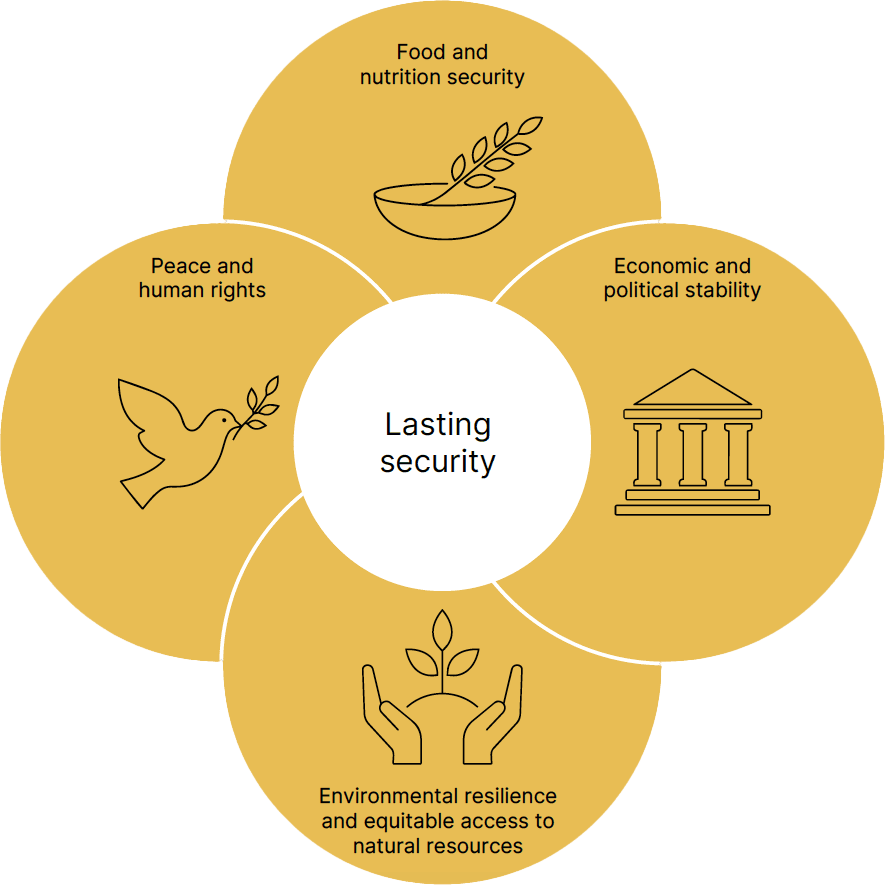
Together, these contributions highlight the need to move beyond siloed approaches: food security cannot be treated in isolation from social cohesion, political stability, economic resilience, environmental sustainability, and peace.
It must be understood as an integral component of a broader concept of security. As the 2026 Global Hunger Index argues, security frameworks that focus primarily on states and borders are insufficient in an era of interconnected and overlapping crises and must prepare for compound and cross-border shocks. Peace and security policies cannot sustainably prevent or resolve crises without protecting people’s access to food and livelihoods, and upholding their right to adequate food.
Placing the right to adequate food at the center of peace and security policymaking is therefore not only a moral and legal imperative. It is an investment in society's capacity to withstand shocks while upholding people’s dignity.