The relationship between food security and security plays out differently across the world. The following essays bring together perspectives from different regions, illustrating how conflict, climate change, inequality, geopolitical tensions, and disruptions to food systems interact in distinct regional contexts.
Renewed militarization, geopolitical tensions, and intensifying power politics are placing state-centered notions of security increasingly at the forefront of political agendas. Yet today's interconnected crises expose the limits of viewing security primarily through this lens. Armed conflict, climate change, environmental degradation, economic shocks, inequality, and forced displacement often reinforce one another in ways that transcend traditional policy boundaries.
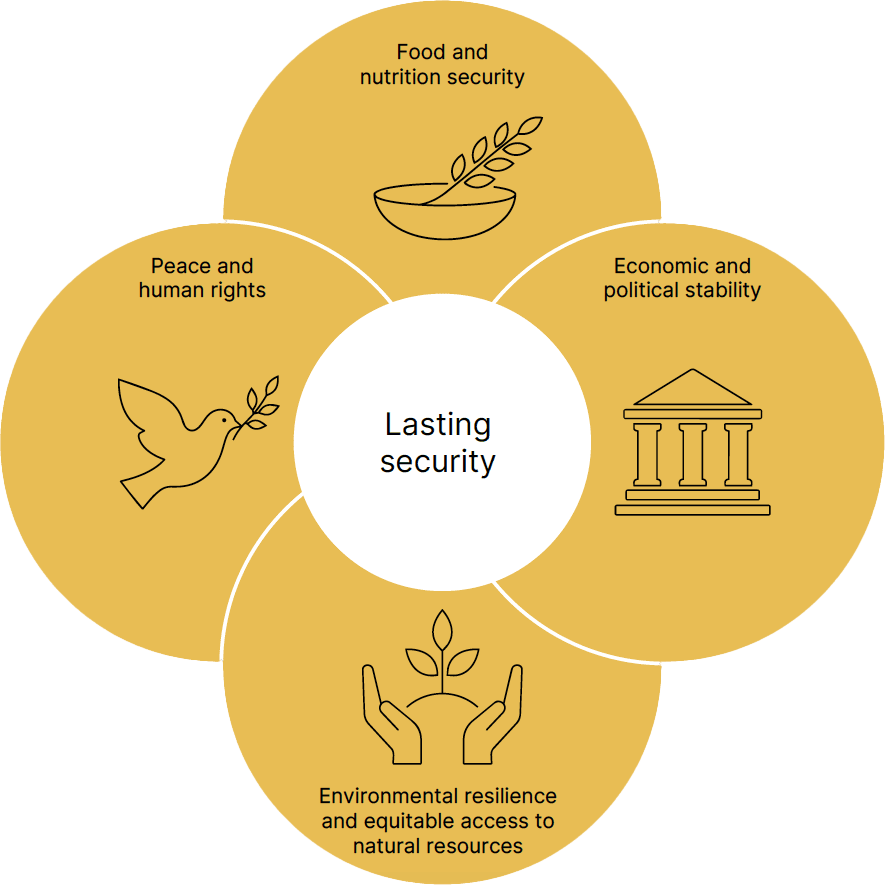
Food security lies at the intersection of many of these dynamics. Conflict remains one of the most destructive drivers of hunger, disrupting food production, destroying livelihoods, and displacing millions of people. At the same time, food insecurity can deepen vulnerabilities and increase pressure on societies and institutions, demonstrating that security depends not only on the absence of conflict but also on people's ability to access adequate food and sustain their livelihoods. Recognizing these interconnections, the 2026 Global Hunger Index argues that food security is not only shaped by peace and stability but is itself an integral component of a broader concept of security.
To explore what this means in practice, the following essays examine what "No Security Without Food Security" means in different regional contexts. Together, the essay authors explore how the relationship between food security and security differs across the world, shaped by distinct political, environmental, and socioeconomic realities.
The views expressed here are those of the authors and do not necessarily reflect the views of the Global Hunger Index (GHI), its partner organizations, or the authors' affiliated institutions.

The West Asia and North Africa (WANA) region faces a food security dilemma rooted in water scarcity, energy dependence, climate- and water-related shocks, conflict, and global market volatility.

The recent convergence of climate shocks, geopolitical conflict, supply chain disruptions, financial instability, and democratic fragility has revealed that food security in Europe is inseparable from broader questions of national and regional security.

Asia is highly exposed to climate-driven food insecurity, yet adaptation finance flows to the region remain inadequate relative to the scale of its exposure and needs.

The disruptions to trade unfolding in the Strait of Hormuz have rippled through the Horn of Africa (HoA)—here comprising Djibouti, Ethiopia, Eritrea, Kenya, Somalia, South Sudan, Sudan, and Uganda—further eroding the region's already fragile baseline of stability and food security.

Food and nutrition security is particularly fragile in the Sahel region as it faces severe climatic conditions and an entanglement of economic, health, and security crises (Olivier de Sardan 2023).

Global military expenditures to ensure security continue to reach record levels, yet hundreds of millions of people still experience hunger (Liang et al.2026; FAO et al. 2026b). This contrast raises a deceptively simple question: What security, and for whom?
Across regions, the threats may differ—armed conflict, climate change, geopolitical tensions, water scarcity, economic shocks, or fragile institutions—but the authors generally agree that societies are more secure when their food systems are resilient, inclusive, and able to ensure access to adequate food for all.
The regional perspectives show that food insecurity is rarely an isolated problem. It is linked to inequality and exclusion in Latin America, reinforces cycles of violence and instability in the Sahel, exposes vulnerabilities to external shocks in the Horn of Africa, reflects deep interdependencies between water, energy, and food systems in West Asia and North Africa, and is increasingly shaped by climate risks across Asia. Even in Europe, where widespread famine is unlikely, maintaining nutrition continuity has become an important element of resilience and preparedness.
Together, these contributions highlight the need to move beyond siloed approaches: food security cannot be treated in isolation from social cohesion, political stability, economic resilience, environmental sustainability, and peace.
It must be understood as an integral component of a broader concept of security. As the 2026 Global Hunger Index argues, security frameworks that focus primarily on states and borders are insufficient in an era of interconnected and overlapping crises and must prepare for compound and cross-border shocks. Peace and security policies cannot sustainably prevent or resolve crises without protecting people’s access to food and livelihoods, and upholding their right to adequate food.
Placing the right to adequate food at the center of peace and security policymaking is therefore not only a moral and legal imperative. It is an investment in society's capacity to withstand shocks while upholding people’s dignity.