en de

ABOUT THE GLOBAL HUNGER INDEX SCORES

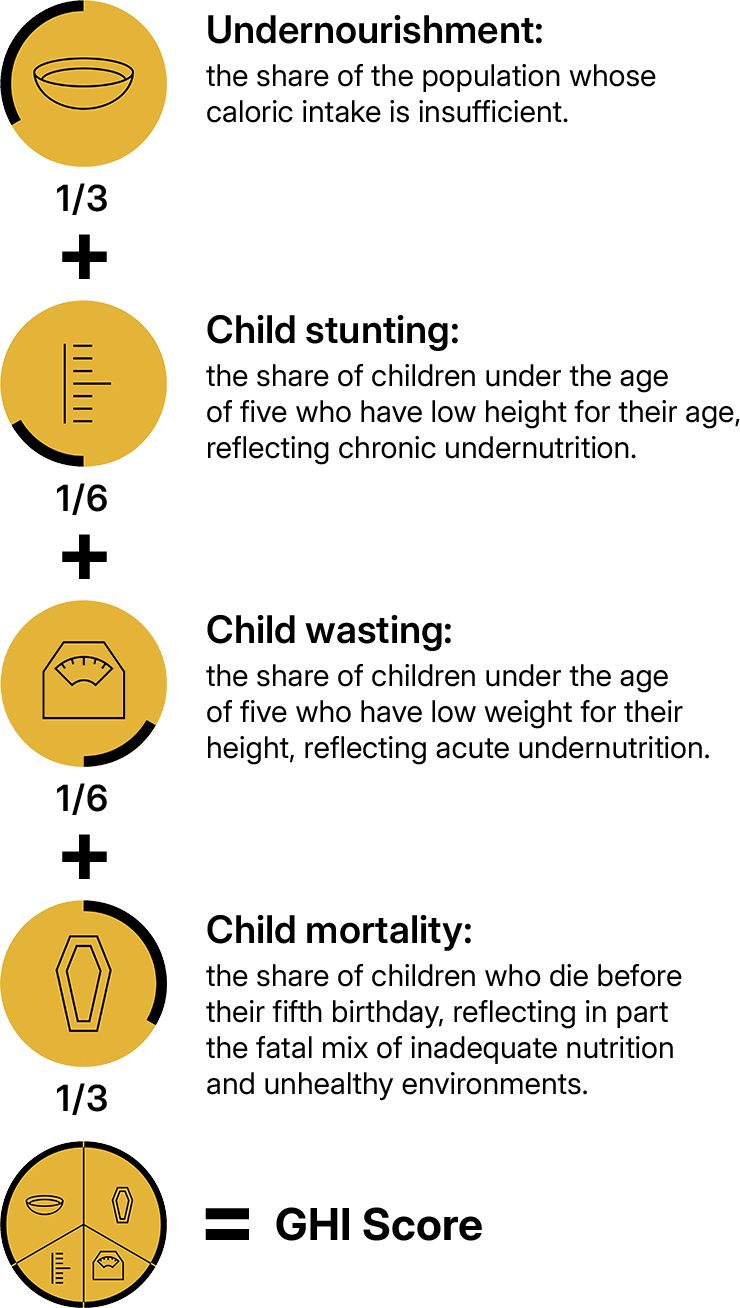
The Global Hunger Index (GHI) is a tool for comprehensively measuring and tracking hunger at global, regional, and national levels. GHI scores are based on the values of four component indicators:
Undernourishment

Undernourishment: the share of the population with insufficient caloric intake.

Child Stunting

Child stunting: the share of children under age five who have low height for their age, reflecting chronic undernutrition.

Child Wasting

Child wasting: the share of children under age five who have low weight for their height, reflecting acute undernutrition.

Child Mortality

Child mortality: the share of children who die before their fifth birthday, partly reflecting the fatal mix of inadequate nutrition and unhealthy environments.

Based on the values of the four indicators, a GHI score is calculated on a 100-point scale reflecting the severity of hunger, where 0 is the best possible score (no hunger) and 100 is the worst. Each country’s GHI score is classified by severity, from low to extremely alarming.

Read more

To print any country profile, please click on the Print button on the webpage.

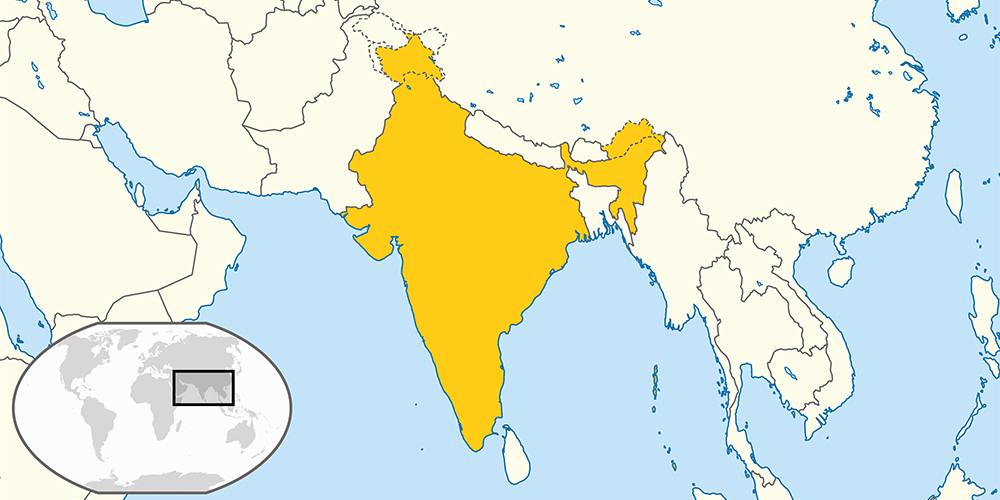
India

In the 2022 Global Hunger Index, India ranks 107th out of the 121 countries with sufficient data to calculate 2022 GHI scores. With a score of 29.1, India has a level of hunger that is serious.


≤ 9.9
low
10.0–19.9
moderate
20.0–34.9
serious
35.0–49.9
alarming
≥ 50.0
extremely alarming


Note: Data for GHI scores, child wasting, and child stunting are from 1998–2002 (2000), 2005–2009 (2007), 2012–2016 (2014), and 2017–2021 (2022). Data for undernourishment are from 2000–2002 (2000), 2006–2008 (2007), 2013–2015 (2014), and 2019–2021 (2022). Data for child mortality are from 2000, 2007, 2014, and 2020 (2022). See Methodology for the formula for calculating GHI scores and the sources from which the data are compiled. The boundaries and names shown and the designations used on maps on this page do not imply official endorsement or acceptance by Welthungerhilfe (WHH) or Concern Worldwide.

Frequently Asked Questions

How is “Hunger” defined?

The problem of hunger is complex, and different terms are used to describe its various forms. Hunger is usually understood to refer to the distress associated with a lack of sufficient calories. The Food and Agriculture Organization of the United Nations (FAO) defines food deprivation, or undernourishment, as the habitual (or chronic) consumption of too few calories to provide the minimum dietary energy an individual requires to live a healthy and productive life, given that person’s sex, age, stature, and physical activity level. At its most extreme, hunger can lead to starvation and famine.

However, hunger is not limited to a lack of calories nor is it always deadly. Hidden hunger refers to a lack of vitamins and minerals. According to the World Health Organization and UN Food and Agriculture Organization, hidden hunger occurs when the quality of food people eat does not meet their nutrient requirements, so the food is deficient in micronutrients such as the vitamins and minerals that they need for their growth and development.

In the Global Hunger Index reports, “hunger” refers to the index based on the four component indicators (undernourishment, child stunting, child wasting, and child mortality). Taken together, the component indicators reflect deficiencies in calories as well as in micronutrients, and may result from a range of underlying factors, including household food insecurity; inadequate maternal health or childcare practices; or inadequate access to health services, safe water, and sanitation.

The GHI is not just a measure of calorie deficiencies, nor is that the only aspect of hunger that is important. There are huge opportunities for India to tackle these other aspects of hunger and undernutrition, just as it successfully tackled famine in past decades.

Can I compare the 2022 GHI score to the GHI score of 2021?

No—GHI scores are comparable within each year’s report, but not between different years’ reports. The current and historical data on which the GHI scores are based are continually being revised and improved by the United Nations agencies that compile them, and each year’s GHI report reflects these changes. Comparing scores between reports may create the impression that hunger has changed positively or negatively from year to year, whereas in some cases the change may partly or fully reflect a data revision. In order to show progress over time, we produce GHI scores for past reference years such that the data used for the calculations do not come from overlapping years. The 2022 GHI report includes 2000, 2007, 2014, and 2022 GHI scores and these are all produced using the latest revised datasets and can be used for comparing progress over time. For more information on the GHI methodology, please see Methodology

What does it mean that the 2022 GHI score for India is higher than the 2014 GHI score?

It means that the GHI score for India has shown a slight worsening, with its GHI score increasing from 28.2 according to its 2014 GHI score to 29.1 according to its 2022 GHI score.

Why are the children’s centric indicators important for measuring hunger and undernourishment?

Three out of four indicators used in the calculation of the Global Hunger Index relate primarily to children because children are particularly vulnerable to nutritional deficiencies. The most critical time for good nutrition is the 1000-day window between the mother's pregnancy and a child's second birthday. Child stunting has been shown to be associated with impaired early motor and cognitive development, with potentially life-long consequences for the individual and society as a whole. Child wasting is the most immediate, visible and life-threatening form of malnutrition, resulting from the failure to prevent malnutrition among the most vulnerable children. Child mortality reflects that death is the most serious consequence of hunger, and children are the most vulnerable. It also improves the GHI’s ability to reflect deficiencies of essential vitamins and minerals.

Who wrote the GHI?

The Global Hunger Index is compiled by a team of technical experts and is a peer-reviewed publication. The peer-review process is of the highest standard to guarantee independent scrutiny of academic work. GHI score calculations for all countries in the report are based on the same methodology.

What progress has India made according to the GHI?

Since 2000, India has made substantial progress, but there are still areas of concern, particularly regarding child nutrition. India’s GHI score has decreased from a 2000 GHI score of 38.8 points—considered alarming—to a 2022 GHI score of 29.1—considered serious. India’s proportion of undernourished in the population is considered to be at a medium level, and its under-five child mortality rate is considered low. While child stunting has seen a significant decrease—from 54.2 percent in 1998–1999 to 35.5 percent in 2019–2021—it is still considered very high. At 19.3 percent—according to the latest data—India has the highest child wasting rate of all countries covered in the GHI. This rate is higher than it was in 1998–1999, when it was 17.1 percent.

The 2022 Global Hunger Index assesses the hunger situation on a global and regional level as well as the situation in 136 countries, of which 121 had sufficient data to calculate 2022 GHI scores. The GHI is a measure of development outcomes in the domain of hunger. It is important to differentiate between policy interventions and their outcomes, so that the effectiveness of government programs and other interventions in improving outcomes can be evaluated.

Please note: GHI scores and rankings are comparable only within each year’s report, not between different years’ reports, owing to revisions of the source data and methodology. To track a country’s GHI performance over time, each report includes GHI scores and indicator data for three reference years. In the 2022 report, India’s GHI scores can be directly compared with its GHI scores for 2000, 2007, and 2014.

How can I compare GHI results over time?

It is important to note that GHI scores, rankings, and indicator values are comparable only within each year’s report, not between different years’ reports, owing to revisions of the source data and methodology. The current and historical data on which the GHI scores are based are continually being revised and improved by the United Nations and other multilateral agencies that compile them, and each year’s GHI report reflects these changes. Comparing scores between reports may create the impression that hunger has changed positively or negatively in a specific country from year to year, whereas in some cases the change may partly or fully reflect a data revision.

Moreover, the methodology for calculating GHI scores has been revised in the past and may be revised again in the future. In 2015, for example, the GHI methodology was changed to include data on child stunting and wasting and to standardize the values. This change caused a major shift in the GHI scores, and the GHI Severity Scale was modified to reflect this shift. In the GHI reports published since 2015, almost all countries have had much higher GHI scores compared with their scores in reports published in 2014 and earlier. This does not necessarily mean their hunger levels rose in 2015—the higher scores merely reflect the revision of the methodology.

In addition to the data and methodology revisions described above, different countries are included in the ranking every year. This is due in part to data availability—the set of countries for which sufficient data are available to calculate GHI scores varies from year to year. If a country’s ranking changes from one year to the next, this may be, in part, because it is being compared with a different group of countries. In 2022 for example, data to calculate GHI scores was available for 121 countries, compared with only 116 in 2021. Furthermore, the ranking system was changed in 2016 to include all of the countries in the report rather than only those with a GHI score of 5 or above. This added many countries with low scores to the ranking that had not been previously included.

To track a country’s GHI performance over time, each report includes GHI scores and indicator data for three reference years. 2022 GHI scores can be directly compared with GHI scores for 2000, 2007, and 2014 as reported in the ranking. The reference years are selected to provide an assessment of progress over time while also ensuring there is no overlap in the range of years from which the data are drawn.

Which data were used to calculate the 2022 GHI score for India?

GHI scores are based on data and estimates for four component indicators—undernourishment, child stunting, child wasting, and under-five mortality—drawing on data from the United Nations and other multilateral agencies. The GHI report includes the most up-to-date data available at the time of its cut-off for data compilation in July and applies the same standards to all countries within the report to ensure comparability.

For India’s 2022 GHI score, data on the four component indicators came from the following sources:

  • Undernourishment values are from the 2022 edition of the FAO Food Security Indicators (published July 6, 2022). The prevalence of undernourishment indicator is assessed by FAO using Food Balance Sheet data from each country. It measures the proportion of the population with inadequate access to calories and is based on data regarding the food supply in the country (see "How is prevalence of undernourishment (PoU) produced?" below for more details).
  • Child stunting and wasting data are from the National Family Health Survey (NFHS-5), 2019–2021: India. The NFHS-5 survey was conducted under the aegis of the Ministry of Health and Family Welfare, Government of India, in collaboration with ICF and the DHS program, one of multiple sources used by the Global Hunger Index in the compilation of stunting and wasting data each year. Child stunting refers to the share of children under the age of five who are stunted (that is, who have low height for their age, reflecting chronic undernutrition). Child wasting refers to the share of children under the age of five who are wasted (that is, who have low weight for their height, reflecting acute undernutrition).
  • Under-five mortality rates are taken from the 2021 edition of the UN IGME (Inter-Agency Group for Child Mortality Estimation) Child Mortality Estimates (published December 20, 2021). Given the wide range in quality and availability of child mortality data at the country level, it is necessary and prudent for the GHI to use the data from UN IGME for all countries to ensure the values have been properly vetted.

Each of the indicator values is standardized and weighted. The standardized scores are aggregated to calculate the GHI score for each country. (For more information on the formula used to calculate the GHI, see Methodology)

How has the prevalence of undernourishment developed in India and other South Asian countries?

As with the GHI, estimates published in previous editions of FAO’s report The State of Food Security and Nutrition in the World cannot be compared, as estimates are revised between editions. When FAO released the latest estimates for 2019–2021, it also revised previous estimates and provided comparable estimates for 2018–2020. FAO regularly updates its estimates of prevalence of undernourishment, taking into account availability of new data. In its database, FAO provides up-to-date data that are comparable over time. According to its Suite of Food Security Indicators (accessed on July 14, 2022), India’s prevalence of undernourishment values for 2016–18, 2017–19, 2018–20, and 2019–2021 are 13.2, 13,3, 14.6, and 16.3, respectively.

The world as a whole is facing tremendous challenges posed by the Covid-19 pandemic; conflicts, including the war in Ukraine; and climate change. This is also reflected in recent increases in prevalence of undernourishment in many countries, including AfghanistanNepal, and Pakistan. As per FAO’s Food Security Indicators, their prevalence of undernourishment values have developed as follows:

Country Prevalence of Undernourishment (%) Change (percentage points)
  2013-2015 2017-2019 2018-2020 2019-2021 2019–2021 over 2018–2020 2019–2021 over 2013–2015
Afghanistan 20.7 24.0 26.9 29.8 +2.9 +9.1
Bangladesh 14.1 11.5 11.0 11.4 +0.4 -2.7
India 14.8 13.3 14.6 16.3 +1.7 +1.5
Nepal 6.1 4.3 4.8 5.5 +0.7 -0.6
Pakistan 13.4 12.3 14.1 16.9 +2.8 +3.5
Sri Lanka 6.0 4.1 3.7 3.4 -0.3 -2.6
How is prevalence of undernourishment (PoU) produced?

The prevalence of undernourishment indicator is calculated by the experts of the Food and Agriculture Organization of the United Nations (FAO) using several factors. Prevalence of Undernourishment takes into account the average per capita availability of food supply as obtained through carefully constructed food balance sheets. Food balance sheets are primarily based on data officially reported by the member countries including India.

Prevalence of Undernourishment also takes into account the calorie requirements of the population (based on data on age distribution for men and women, distribution of heights and other key determinants of dietary energy requirements). Also, Prevalence of Undernourishment takes into account the distribution of calorie intake in the population as estimated through official consumption surveys conducted by governments. In cases where governments have not provided recent consumption survey data, changes in this one aspect of the Prevalence of Undernourishment calculation, the distribution of calorie intake in the population, are estimated using the Food Insecurity Experience Scale (FIES) survey data, which has a sample size of 3,000 in India. It is public knowledge that India has not collected and disseminated a household consumption survey since 2011, i.e. 11 years ago. This aspect of the prevalence of undernourishment methodology is clearly described in FAO’s State of Food Security and Nutrition in the World 2022 report (Annex 1B).

Prevalence of undernourishment values calculated in this way are still recognized as valid measures of hunger and are used as measures towards progress in the Sustainable Development Goals. Likewise, the Global Hunger Index uses prevalence of undernourishment values reported by FAO whether or not governments have provided official consumption survey data.

What is the reason for the choice of GHI indicators?

The problem of hunger is complex. The GHI includes four indicators to reflect the multidimensional nature of hunger. Together, they reflect deficiencies in calories as well as in micronutrients.

The Global Hunger Index is a report that is peer reviewed by external experts. The methodology has long been established and tested.

By combining the proportion of undernourished in the population (1/3 of the GHI score) with the indicators relating to children under age five (2/3 of the GHI score), the GHI ensures that both the food supply situation of the population as a whole and the effects of inadequate nutrition within a particularly vulnerable subset of the population are captured. Inequitable resource allocations between households and within households are also taken into consideration to reflect the effect of the latter on the physical well-being of children. Sufficient food availability at the household level does not guarantee that all household members benefit from it in equal measure.

Children’s nutritional status deserves particular attention because a deficiency of nutrients places them at high risk of physical and mental impairment and death. For many children who die from infectious diseases, the indirect cause of death is a weakened immune system due to a lack of dietary energy, vitamins, and minerals. Since the first three indicators—the proportion of undernourished and the prevalence of stunting and wasting in children—do not capture premature death as the most tragic consequence of hunger, the under-five mortality rate is also included.

The international community—including India—has agreed upon the Sustainable Development Goals (SDGs), and the GHI uses indicators that are part of the internationally recognized indicator set to measure progress toward the SDGs. The prevalence of undernourishment is recognized as one indicator for UN Sustainable Development Goal (SDG) 2.1 on ensuring access to safe, nutritious, and sufficient food for all. Reducing child stunting and wasting by 2025 is not only an internationally agreed World Health Assembly target, but child stunting and wasting rates are also recognized as indicators to track progress on SDG 2.2 on ending all forms of malnutrition. Reducing preventable deaths of children under five years of age is listed as SDG 3.2.


This website uses cookies to improve user experience.
https://www.globalhungerindex.org/inner.php/ajax